
Workwear Quality Control from Approved Sample to Bulk Production

Executive Summary
Workwear bulk quality control starts with an approved pre-production sample (PPS) and a version-controlled tech pack. Material verification, first-piece approval, in-line inspections and final random inspection help identify deviations before shipment. Inspection plans and acceptance criteria shall be mutually agreed prior to production kick-off.
For global OEM buyers, workwear quality consistency is the core of stable long-term cooperation. Once the pre-production sample (PPS) gets signed off, the biggest challenge is replicating the same fabric, fit, construction and finish across thousands of bulk garments. Excessive batch-to-batch variation, missed specifications and hidden defects will cause shipment delays, end-customer complaints and brand damage.
This article outlines LEAPY’s end-to-end factory QC workflow from approved sample handover to final shipment. It covers fabric incoming inspection, in-line production audits, final random inspection, test validation and corrective-action mechanisms, helping global OEM distributors and enterprise sourcing teams set clear quality-acceptance criteria and reduce bulk-order risks. View more workwear products and services.
1. Pre-Production Validation After Sample Approval
Definition note: Pre-production Sample (PPS) is the signed-off reference for mass-production, different from sales sample, size-set sample and first-piece sample. It does not guarantee 100% identical output for all bulk lots. Version of tech pack, sample sign-off date and sample ID shall be documented for acceptance reference.
Bulk quality control starts before cutting any fabric, not on the sewing line. After buyers approve the PPS, our QC team runs a cross-check against the signed sample and technical pack:
- Fabric & trims pre-confirmation: All incoming bulk fabric, webbing, buttons, zippers and reflective tapes are cross-referenced with sample swatches. We verify fabric GSM, colour shade, fibre composition and physical performance before release to the cutting room. Incoming inspection records include lot numbers, roll IDs, inspection scope, test items and disposition results. Laboratory tests will only be arranged for agreed items rather than every incoming material batch.
- Technical pack alignment: Pattern grading, stitch specs, seam allowance and artwork placement are double-checked. Any deviation from the approved sample triggers production hold and revision before production kick-off.
- First Piece Inspection (FPI): After the first complete garment off the line is finished, QC carries out full-scope audit covering construction, measurements and trims. Clear FPI check scope, responsible person and release records are required. Mass-production sewing may only continue upon FPI approval.
2. In-Line Production QC & Construction Benchmarks
Workwear endures heavy wear, repeated washing and harsh working environments, so construction integrity is critical. In-line check frequency follows mutually agreed inspection plans, adjusted according to process risk level:
- Hourly in-line checkpoint: Each sewing station conducts self-inspection. Our dedicated line QC performs random garment checks every hour. Key focus items: seam strength, stitch density, pocket reinforcement and label placement. Tape-sealing check is only applied for styles requiring sealed seams.
- Critical risk points focus audit: High-stress areas like shoulder seams, crotch seams, knee-reinforcement patches and reflective-strip attachment get extra inspection to avoid seam burst or component peeling during end-user usage.
- Dimensional check: Garment measurements are sampled continuously to prevent size drift across bulk batches. Measured positions, measuring methodology, size range, agreed tolerances and deviation-handling rules are defined in advance per project requirements.
3. Final Random Inspection & Lab Performance Testing
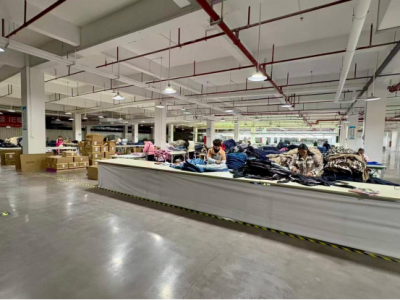
Leapy‑inspection‑workshop
When bulk garments are fully finished, we perform final random inspection following agreed sampling standards such as ISO 2859-1 / ANSI/ASQ Z1.4. Sampling plan, inspection level, normal/tightened scheme, sample size and Ac/Re values for each defect category shall be defined in the contract per buyer requirements. Third-party lab tests are arranged subject to buyer request:
- Visual inspection: Check staining, fabric defects, mis-printing, crooked seams, loose threads and colour shading within one shipment.
- Performance testing: Wash shrinkage, colour fastness, tensile strength, abrasion resistance, pilling and water-repellency can be tested for workwear. Note: Water-repellency is not equivalent to waterproof performance. For waterproof styles, hydrostatic head and seam waterproof performance shall be assessed separately as contracted. Test reports corresponding to tested batches can be provided for buyer review. Test reports do not equal product certification.
- Packing audit: Verify hangtag, size label, polybag marking and carton labelling match your packing specification.
4. NonConformity Handling & Shipment Release Rules
If non-conformities are found during inspection:
- Segregate defective lots immediately and put related batches on hold pending root-cause analysis.
- Propose corrective-action options including rework or defective-material replacement. Downgrade disposition requires written authorisation from buyer; downgrade shall never replace mandatory safety requirements. Responsible persons, notification channels and corrective-action closure records shall be kept.
- Complete re-inspection against agreed sampling scheme after rework. Restore goods to compliant packing status before shipment authorisation.
- All deviation records are archived for future-batch reference, to prevent recurrence of identical issues.
Learn more about our factory and quality system on About Us. For inquiries, please Contact Us
Workwear QC Acceptance Checklist
|
QC CHECK STAGE |
WHAT IS CHECKED |
AGREED ACCEPTANCE CRITERIA |
PROVIDED RECORDS |
|---|---|---|---|
|
Fabric Incoming Inspection |
Fabric swatch comparison, colour, fabric weight |
Fabric weight and shade tolerances as agreed in approved specification; colour evaluated under agreed light source |
Incoming material inspection record |
|
Sewing & Seam Construction |
Stitch performance, seam strength, reinforcement |
Stitch count per spec; no skipped stitches, no seam slippage |
In-line QC log |
|
Finishing & Decoration |
Logo, print and reflective application |
Artwork aligned; no peeling or cracking per agreed standard |
Finished-garment visual check record |
|
Packing & Documentation |
Carton marking, label, supporting documents |
Carton marking & labels match PO; relevant test reports available upon request |
Packing audit record |
Technical Quality Control Checklist for Global OEM Buyers
Before confirming bulk shipment, buyers can verify these key quality metrics:
- Cross-check bulk-fabric swatch against the originally approved sample.
- Confirm AQL inspection level and sampling quantity within your contract.
- Request test reports for required performance items (colour fastness, shrinkage, tensile strength). Reports shall correspond to actual inspected batches.
- Review size-set samples before mass cutting for large-volume orders.
- Confirm corrective-action protocol: how defects will be handled if non-conformities are discovered.
Buyer Checklist: Prepare Your Workwear OEM Quality Brief
When sending your RFQ to our B2B team, prepare these items to make QC expectations clear:
- Approved PPS sample + signed tech pack
- Agreed AQL inspection level and defect classification
- Required lab-test list and corresponding testing standards (ISO / EN etc.)
- Complete packing requirements, labelling and carton specifications
- Non-conformity handling & rework agreement
Frequently Asked Questions (FAQ)
1. How do you manage colour consistency across bulk workwear orders?
We lock fabric dye lots prior to cutting. Each incoming fabric roll is compared side-by-side against the approved master swatch under standard light-box conditions. Any roll out of agreed colour tolerance will be rejected. Single-dye-lot production depends on order quantity and material supply conditions, and cannot be guaranteed for every project. We adopt traceability measures to reduce shade variation, and keep records for abnormal lots.
2. What AQL level do you recommend for OEM workwear bulk inspection?
An inspection plan may specify AQL 2.5 for major defects and AQL 4.0 for minor defects, subject to buyer approval and applicable sampling standards. This is for reference only. Safety-critical defects shall be separately defined with dedicated acceptance rules.
3. Will you hold shipment if the final inspection fails?
Yes. In case of failing final random inspection, related batches will be put on hold per agreed procedure. We will share full defect reports, root-cause analysis and corrective-action proposals. Rework and re-inspection will be arranged. Shipment can only proceed after re-inspection passes and obtains release authorisation. Any exception acceptance must follow contract requirements and safety boundaries.
4.Can we appoint our own thirdparty inspector to audit the factory and bulk goods?
Absolutely. We welcome buyer-appointed third-party inspectors to carry out on-site audits, in-line checks or final random inspection at our factory. We will fully cooperate and prepare all garments and supporting documents for your inspector.
5. How do you control quality if the order includes mixed styles and multiple colourways?
We implement identification and traceability by style number, colourway, size and production batch. Sampling plans are formulated based on project risks and contract requirements, covering all variants. Each colourway follows its own fabric-swatch approval process. During final inspection, sampling covers all contracted styles and colourways.