LEAPY and ADEO Explore Recycling Garment Fabric Scraps for Building Materials

Introduction
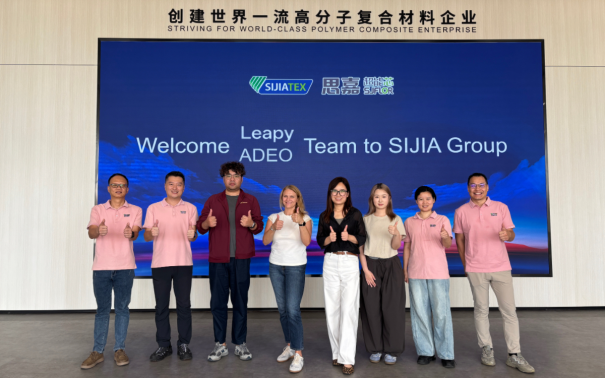
LEAPY has been exploring a potential cooperation on fabric recycling with ADEO (Leroy Merlin) from France, one of Europe’s leading building materials retail groups. This cross-industry exploration aims to find a more resource-efficient use for garment production offcuts by turning them into recycled materials for building applications.
At a Glance: Project Snapshot
Goal: Turn selected production offcuts from garment cutting into recycled material feedstock for building applications.
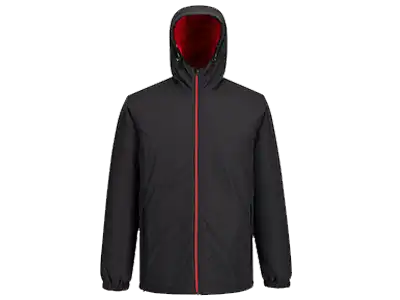
Feedstock: Polyester fabric scraps (170T / 190T / 210T constructions) from rain coat and windbreaker lines, subject to material assessment.
Partners: LEAPY (apparel manufacturer) and ADEO / Leroy Merlin (building materials retailer).
Current stage: Early exploration; processes and applications are being evaluated and confirmed with the processing partner.
Intended use: Building and home improvement materials
Cooperation Background: A Shared Sustainability Interest
ADEO, the group behind the Leroy Merlin brand, operates a broad retail network across markets such as France, Germany and the United Kingdom. According to ADEO’s published sustainability framework, the group focuses on waste reduction, recycling and resource regeneration, and applies requirements on the traceability, stability and compliance of recycled raw materials.
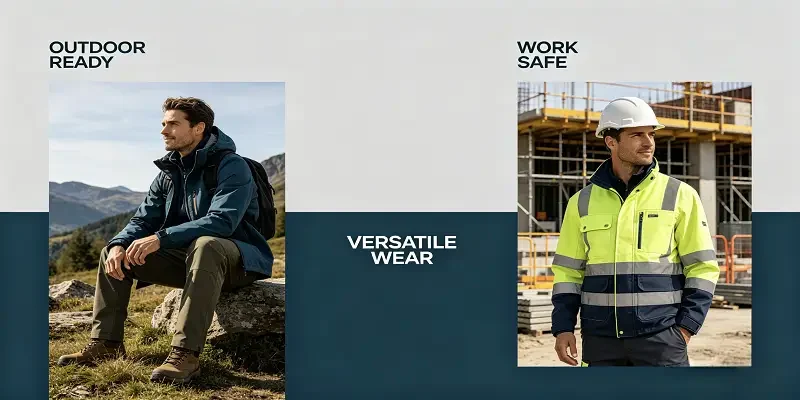
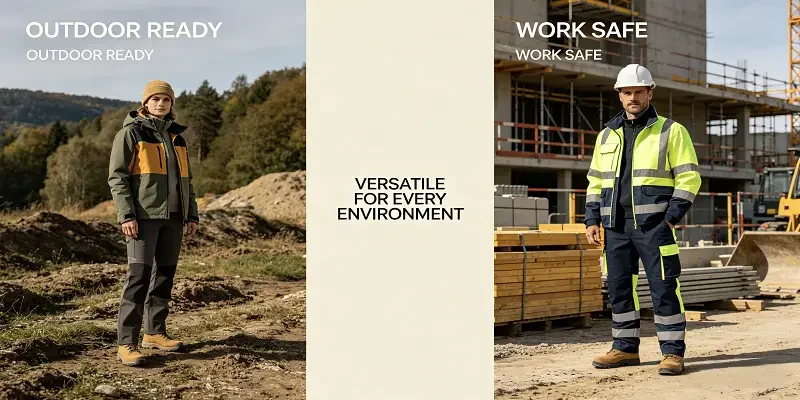
LEAPY manufactures outdoor protective apparel, including rain coats and windbreakers, which are commonly made from lightweight polyester fabrics in 170T / 190T / 210T constructions. Pattern cutting and production generate fabric offcuts. As with much of the apparel industry, a share of these scraps is not fully recovered, and improving how they are handled supports our sustainability objectives for European clients. This cross-industry cooperation is designed to explore a more resource-efficient use of textile waste across sectors.
Recycling Process: From Fabric Scraps to Building Materials
This partnership explores a cross-industry value chain: garment production scraps → recycling processing → building material feedstock. Fabric offcuts from our rain coat and windbreaker lines (170T / 190T / 210T polyester constructions) are the candidate feedstock. Rather than reprocessing them into new yarn, we are exploring a physical recycling route for non-woven building material applications. Process steps and equipment are being confirmed with the processing partner and are subject to testing.
|
No. |
Process |
Detailed Description |
Control Key Points |
|---|---|---|---|
|
1 |
Sorting, Purification & Shredding |
Collect selected polyester fabric scraps (170T/190T/210T constructions) generated from cutting rain coats and windbreakers, subject to assessment for coatings (e.g. PU/PVC), blends, prints or flame retardants. Remove accessories such as zippers, snaps and webbing, and oil-stained or off-spec impurities by manual and mechanical sorting, then shred qualified scraps into uniform fragments. |
Mark and store batches separately and establish source ledgers; control impurity intake to avoid defects in subsequent processing. |
|
2 |
Calendering (process to be confirmed) |
Feed pre-treated polyester fragments into the calender unit. Under controlled temperature and pressure, the material is extruded, plasticized and formed by rollers into even, stable recycled substrate sheets. Equipment, pre-treatment and parameters to be confirmed with the processor. |
Record temperature, pressure and line speed per batch; sample-test sheet thickness, flatness and tensile strength. |
|
3 |
Laminating |
The recycled substrate sheets may be laminated with suitable functional layers (e.g. waterproof, wear-resistant or UV-resistant films), subject to product requirements and testing standards. |
Ensure sufficient bonding strength, no air bubbles or delamination; carry out peel strength tests per batch. |
|
4 |
Cutting, Finishing & Forming |
Cut, trim and surface-treat the composite panels, then perform quality inspection to obtain qualified semi-finished building components. |
Full inspection of appearance, dimensions and functional performance; reject non-conforming products. |
|
5 |
Warehousing & Delivery |
Pack qualified recycled building products, store in warehouse, and prepare for delivery. Potential applications and delivery to ADEO are still under evaluation. |
Attach traceability labels for full-chain tracking, where applicable. |
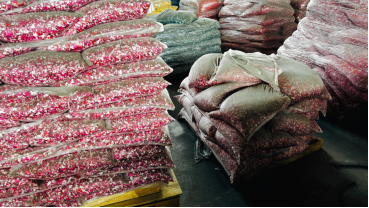
Bags of Recycled Shredded Polymer Material
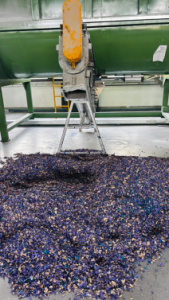
Shredded Polymer Scrap from Recycling Line
Core Advantages of the Recycling Solution (Intended, Subject to Testing)
This physical recycling route is intended to preserve the fundamental properties of the polymer base and to convert waste fabric into commercially viable building material feedstock, enabling cross-category resource reuse. We aim to reduce waste output at the source and extend the lifecycle of polyester fabrics. Performance and commercial viability are subject to testing and detection reports.
Traceability
Supported by this recycling supply chain, we intend to maintain material inventory records and process documentation. Where applicable and subject to third-party verification, batch-level traceability can support European clients’ compliance demands for authenticity and verifiable proof of recycled content.
Market Service Plan
This recycling service is initially being explored for key customers in France, Germany and the UK, subject to partner agreement and market launch status. We will take this project as a benchmark to refine the full workflow — including scrap collection, processing, record-keeping and documentation — and, where feasible, integrate circular capacity into our standard garment supply chain. We aim to help clients understand relevant EU regulatory considerations, such as packaging-related requirements under PPWR and chemical management under REACH, and applicable ESG disclosure expectations, jointly advancing circularity across textile and construction sectors.
Our Sustainability Vision
At LEAPY, sustainability is a long-term responsibility across the supply chain rather than an optional marketing highlight. This cross-industry exploration with ADEO reflects our commitment to looking beyond the conventional “recycle fabric back into garments” mindset. We will continue to explore practical ways to recover production scraps and assess potential applications with our partners.
Frequently Asked Questions (FAQ)
1. What fabric scraps are used for this recycling project?
The candidate feedstock consists of selected production offcuts generated during the cutting and manufacturing of our core outdoor apparel lines, including rain coats and windbreakers. These scraps are made of lightweight polyester fabrics in 170T / 190T / 210T constructions, subject to material assessment for coatings, blends, prints or flame retardants. Before entering the recycling line, scraps go through sorting to remove trims, hardware and contaminated pieces, to support clean, uniform feedstock for subsequent processing. The availability and stability of scrap supply will be confirmed with the processor.
2. Where will the recycled finished products be sold?
Potential building and home improvement applications are still under evaluation. If confirmed, recycled composite materials could be processed into finished building or home improvement products and, subject to partner agreement, sold through ADEO Group’s retail network in Europe, mainly under its Leroy Merlin banner. End products under consideration include decorative panels, indoor lining materials and outdoor building components, giving the original garment scraps a second usable lifecycle in the home improvement and construction sector.
3. Is this recycling chemical recycling or physical recycling?
We are exploring a physical recycling route, with no chemical decomposition or solvent-based treatment involved. Instead of breaking down the polyester polymer at the molecular level, we aim to use heat and mechanical pressure to melt, calender and laminate shredded fabric fragments into solid sheet substrates. Material performance will be based on test results; any comparison of carbon footprint, energy use or environmental impact would require a life-cycle assessment and is not claimed at this stage.
4. Which countries are the priority service markets for this circular program?
The service is initially being explored for customers in France, Germany and the United Kingdom, subject to partner agreement and launch status. These markets were identified as candidate first-phase priorities because they are core operating regions of ADEO Group with mature retail channels, and because they have established environmental regulations. Regulatory and compliance requirements would be assessed separately for each market, including for the UK as a non-EU member. Based on evaluation results, we may gradually consider additional European markets.
5. Can we provide traceability records for fabric scraps?
We intend to maintain batch-level records covering the value chain — from the garment order number and scrap collection source, to sorting, shredding, calendering, laminating and final inspection — where applicable and subject to third-party verification. Process parameters, quality test reports and delivery records may be filed and accessible. We will confirm which documents can be provided to customers. Note that PPWR and REACH are not general recycled-content verification schemes; relevant requirements will be assessed per product and market.