
Fabric In-Coming Inspection: From Roll Check to Cutting Release

Why inspection comes first
In an outerwear order, fabric carries both the largest share of material cost and the most risk: shade variation between dye lots, shrinkage that only shows up after washing, coating and lamination defects, and a width deviation that quietly reduces the cutting yield.
None of these can be corrected efficiently on the sewing line. Once a roll has been cut, the cost of putting it right multiplies. So the rule is simple: no roll goes to cutting until it has been checked, tested where the order requires it, and released.
Where a problem is found, the lot is handled by one of four routes — released with the defect accepted, isolated and held, returned to the supplier, or released under a documented special approval. The decision and its basis are recorded with the lot; it is not left to the cutting room to absorb.
Step 1 — Receiving and documentation
Receiving starts with documents and the physical count. Each delivery is checked against the purchase order and the packing list at the warehouse; the physical check of the fabric itself follows as each roll is opened and inspected.
- Article number, composition and colour confirmed against the order
- Roll count and total metreage against the packing list
- Roll number and dye lot / batch number recorded for every roll — both fields are needed, and both must carry through into the cutting records
- Supplier, delivery date and inspection status logged
Rolls that do not match the order are held separately and not mixed into production. Once a wrong-lot roll is absorbed into the cutting plan, it is almost impossible to trace.
Step 2 — Roll-by-roll inspection
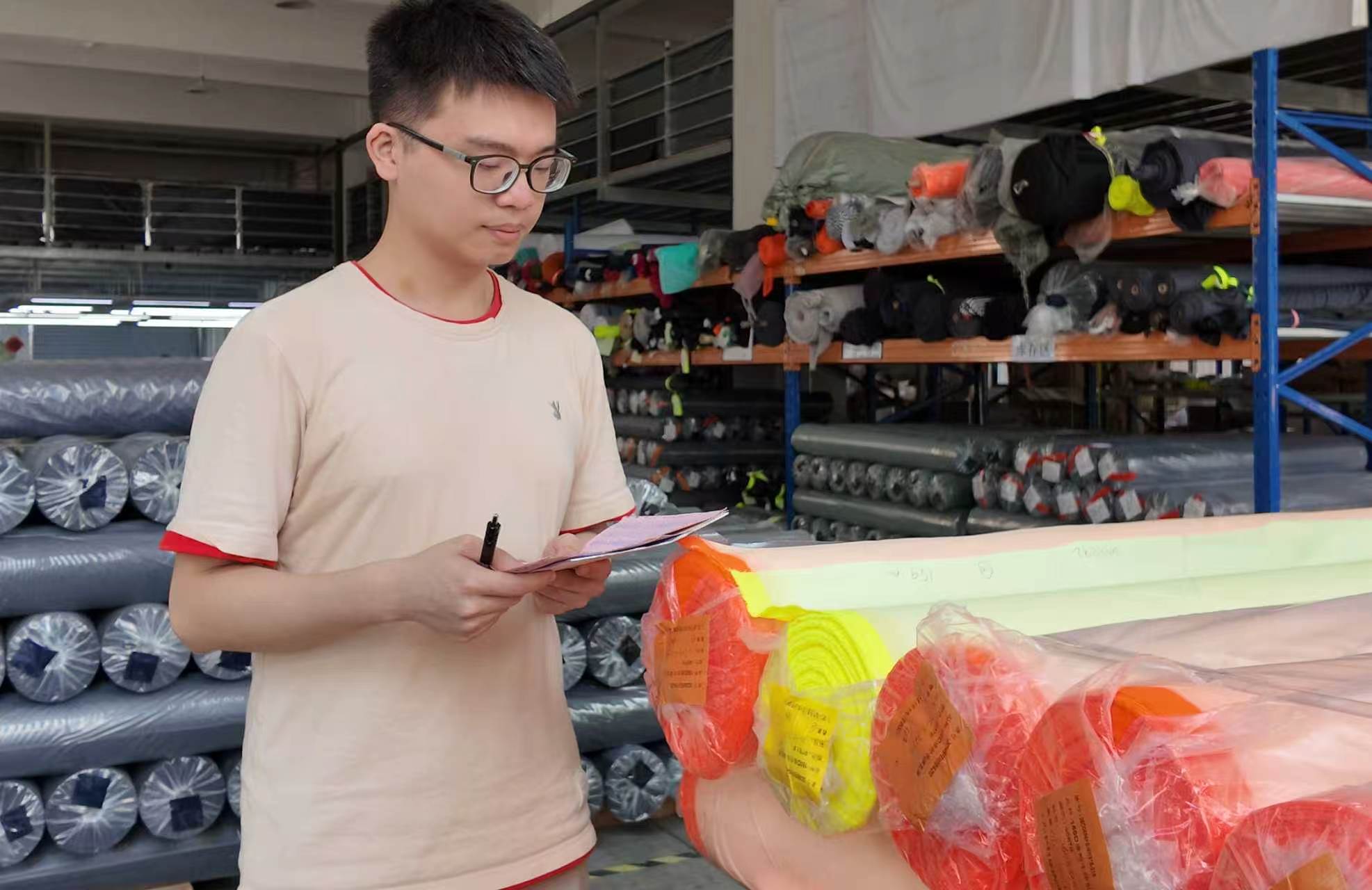
Rolls are inspected on the inspection machine under consistent lighting. Coverage follows what is agreed on the order — full-length inspection of every roll, inspection of defined sections on each roll, or inspection against an agreed sampling plan. Defects are graded with the 4-point system, a widely used method in the apparel industry, against the grading scheme agreed with the buyer.
|
Defect length |
Points |
|---|---|
|
≤ 3 in |
1 |
|
> 3 to ≤ 6 in |
2 |
|
> 6 to ≤ 9 in |
3 |
|
> 9 in |
4 |
What we check on each roll:
- Weaving and knitting faults — slubs, missing picks, needle lines, barré
- Holes and tears, including pin holes from stenters
- Oil, rust and dye stains
- Visible coating and lamination defects — pin holes, bubbles, delamination, uneven adhesive, coating skips. On waterproof shells these are the defects most often caught at the inspection table
- Usable width — measured at several points along the roll
- Selvedge condition and edge curling, which affect both cutting and seam sealing
- Shade variation — along the length of a single roll, not only between rolls
Points are accumulated per roll and normalised to the area basis agreed with the buyer, then judged against the agreed acceptance limit (reference method: ASTM D5430). A roll that exceeds the limit is returned to the supplier or cut around under an approved marker plan; where cut-around is used, the approval and the defect record stay with the lot. Rolls are not quietly pushed into production.
Step 3 — Testing and release
Visual inspection answers "is it damaged", not "will it perform". The checks below are split by where and how they are carried out:
- On-site measurement at receiving — fabric weight (GSM) and usable width against specification
- Lab tests arranged for the order — shrinkage (dimensional stability after washing, per the agreed test method); colourfastness (washing, water, rubbing and light, to the grades required by the buyer); water resistance on functional shells (spray rating, rain test, and hydrostatic head where specified)
- Supplier test reports reviewed against the order requirement
- Certification and compliance documents checked where the order calls for them — restricted substances, recycled content
Seam and tape performance, where sealing is required on coated or laminated shells, is checked on the actual seam or on relevant test specimens, at the operation defined in the order's inspection plan.
Results are filed with the lot record. Where a result fails, the lot is held regardless of how it looked on the inspection table.
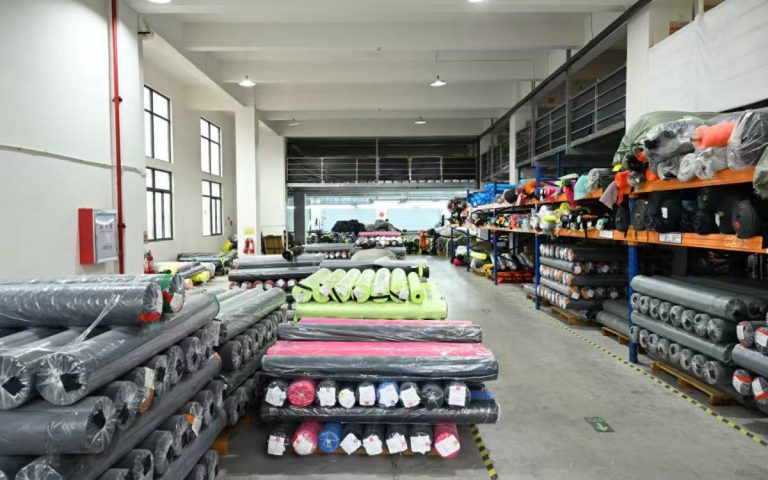
Fabric Warehouse Rolls Storage
Step 4 — Shadelot grouping and the handover to cutting
Once a lot passes, rolls are grouped by approved shade band, not spread evenly by total metreage. Rolls from the same dye lot stay together. Where lots must be mixed, keep the visible panels of each garment within the same approved shade band.
Usable width and shrinkage data are handed over to the cutting room at this stage: if the usable width is narrower than nominal, the marker is recalculated before cutting, not after.
Step 5 — Relaxation before cutting
Rolled fabric carries tension from weaving, finishing and winding. Cut too early and the panels relax after sewing — hem lengths shift, pockets distort, measurements drift out of tolerance.
Fabric is therefore laid out and left to relax before cutting. Resting time is set by fabric structure, elasticity and the process requirements of the order; tension-sensitive fabrics rest longer. Whether relaxation runs after inspection release, or counts as a pre-cutting release condition, is defined in the production plan for each order.
Step 6 — Release and records
Only fabric that has passed inspection, testing where required, and relaxation is released to the next operation. Each release carries: lot number, metreage released, inspection result, test result and the production start date.
That record supports lot-level traceability: if final inspection reveals a shade issue or a coating failure, the lot can be traced back through its dye lot and batch records. Where roll-level traceability is kept, the roll number is linked to the cutting batch, bundle ticket or production record, so the query can go down to the individual roll.
Consistent fabric receiving and inspection forms the first critical gate for garment quality. By identifying risks at the fabric stage, we minimise downstream rework, reduce waste and help deliver stable product performance for every order.