
Water-Repellent vs. Waterproof Workwear: Fabric, Seam Sealing, and Test Data Buyers Should Check

Executive Summary
In B2B protective apparel procurement, confusing Water-Repellent with Waterproof workwear leads to costly spec errors and safety non-compliance. For procurement managers across Europe and North America supplying construction, utility, and logistics teams, a product tag reading “Waterproof” is never a guarantee of real-world rain protection.
Selecting garments for high-risk, all-weather conditions requires looking beyond marketing language. This technical guide outlines the engineering differences between surface water-repellency and genuine waterproofing, key fabric test standards, critical seam sealing requirements, and a checklist for verifying third-party lab reports.
1. Defining the Technical Difference: Water-Repellent vs. Waterproof
Understanding the mechanical distinctions between surface water-repellency and full waterproof protection is essential when aligning apparel specs with job-site exposure.
|
Technical Parameter |
Water-Repellent Workwear |
Waterproof Workwear |
|---|---|---|
|
Primary Mechanism |
Surface tension adjustment via DWR (Durable Water Repellent) finish |
Physical barrier using PU/TPU coatings, membranes, or laminates |
|
Water Behavior |
Causes liquid to bead and roll off under light, short exposure |
Prevents liquid penetration under continuous heavy pressure |
|
Pressure Resistance |
Minimal. Cannot resist physical pressure or shoulder strap loads |
High hydrostatic pressure resistance (verified in mmH2O or kPa) |
|
Seam Construction |
Standard sewn seams; needle holes remain unsealed |
Thermally taped or welded seams across all critical stitch lines |
|
Best-Fit Application |
Occasional light rain, indoor-outdoor shifts, splash protection |
Multi-hour heavy rainfall, high-pressure outdoor operations |
Water-Repellent Fabrics
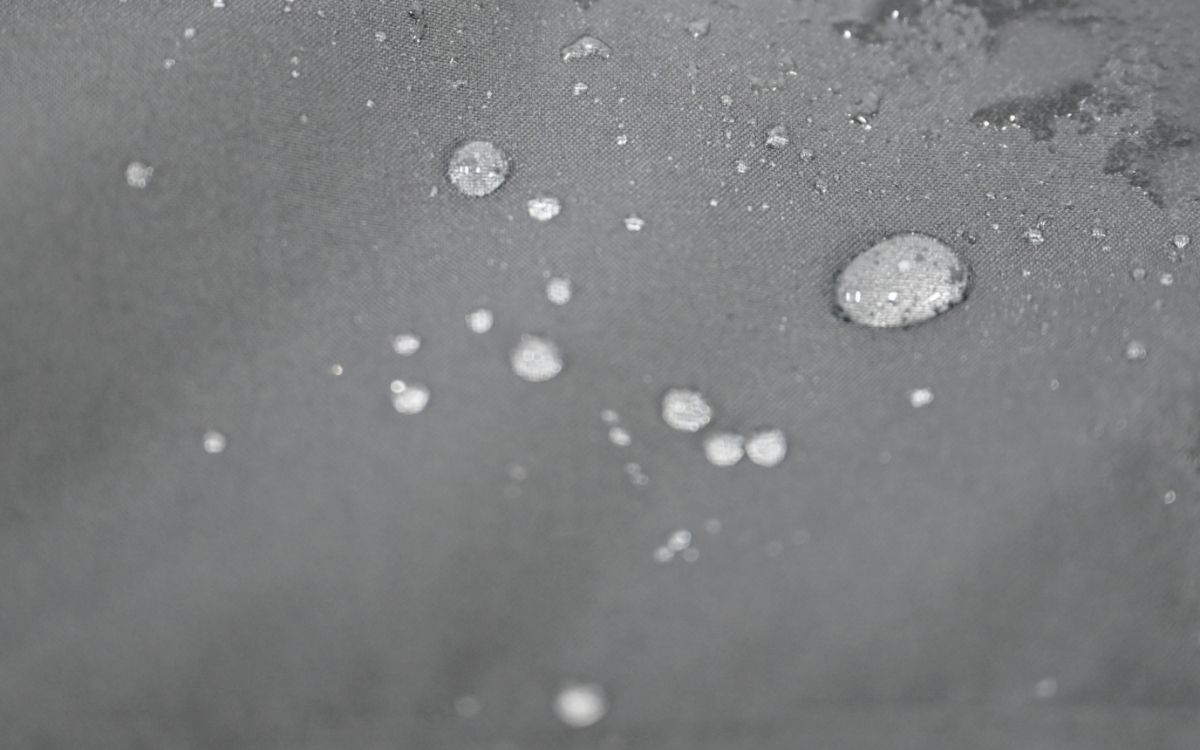
Water-repellent textiles rely on surface treatments (DWR) that increase the contact angle of liquid drops. While this prevents immediate wetting during brief showers, physical pressure—such as leaning against wet equipment, kneeling, or wearing a heavy tool harness—will force water through the fabric weave.
Waterproof Fabrics & Membranes
Genuine waterproofing requires a continuous physical barrier. This is achieved via polyurethane (PU) or thermoplastic polyurethane (TPU) coatings, or laminated membranes (2-layer or 3-layer constructions) that block liquid water molecules while maintaining breathability.
2. Fabric Test Data Buyers Must Verify
Professional buyers should always request official third-party laboratory test reports (e.g., SGS, TÜV, Intertek) rather than vendor summaries.
- [1] Surface DWR Rating: Evaluated via ISO 4920 / AATCC 22 (Spray Test) — Measures surface wetting only.
- [2] Waterproof Capacity: Evaluated via ISO 811 / AATCC 127 (Hydrostatic Head) — Measures resistance under liquid pressure.
- [3] Garment System Integrity: Evaluated via EN 14360 / Rain Tower Tests — Measures complete garment protection.
A. Hydrostatic Head Pressure Resistance
Hydrostatic head testing measures the water pressure a fabric can withstand before three drops penetrate the material.
Benchmark Guidance:
- Light Duty: 3,000 mmH2O to 5,000 mmH2O
- Heavy Industrial Duty: 10,000 mmH2O to 20,000+ mmH2O (required for heavy rain under harness pressure).
- European Compliance: Verify compliance with EN 343 (Protective clothing against rain), noting the hydrostatic pressure class (Class 1 through Class 4).
B. Spray Rating vs. Waterproofing
A fabric can achieve a top spray rating (ISO 5 / AATCC 100) while having zero pressure resistance if it lacks a coating or membrane. Do not accept a spray rating as proof of waterproofing.
C. Breathability & Moisture Vapor Transfer
A waterproof garment lacking breathability traps sweat, causing internal condensation and worker fatigue.
- ISO 11092 (RET): Lower values indicate higher breathability. Target RET < 12 for active physical work.
- ASTM E96 (MVTR): Target ≥ 5,000–10,000 g/m²/24h for active industrial tasks.
3. The Critical Role of Seam Sealing & Garment Engineering
Fabric waterproofing alone does not equal a waterproof garment. Every sewing needle creates microscopic punctures through the fabric and membrane. Without specialized seam treatment, liquid will rapidly leak through stitch lines under rainfall.
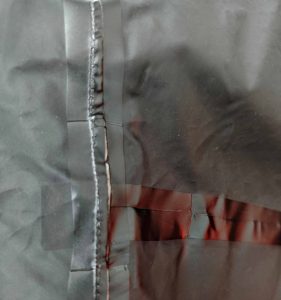
Close-up of heat-sealed waterproof seam tape and overlap patch reinforcement on internal workwear jacket stitches
Seam Taping Techniques
- Hot-Melt Seam Tape: Polyurethane or multi-layer hot-melt tapes are applied using specialized hot-air taping machinery directly over seam allowances.
- Tape Matching: 2-layer fabrics require 2-layer tricot or PU tapes, while 3-layer fabrics require matching 3-layer tapes to ensure thermal expansion stability and adhesion durability.
Critical Inspection Points
When reviewing prototype garments, physically inspect these high-vulnerability zones:
- 3-Way Seam Intersections: Sleeve and crotch intersections require precise tape overlap to prevent micro-gaps.
- Zippers & Pockets: Verify if pockets use waterproof storm flaps or PU-coated waterproof zippers.
- Hood & Collar: Ensure collar-to-hood attachment seams are fully taped.
4. Durability & After-Wash Performance (Retention Data)
Workwear is subjected to heavy mechanical wear, friction, and frequent laundering. Test data generated from raw, unwashed fabric rarely reflects real-world performance after months of use.
What Buyers Must Request:
- After-Wash Hydrostatic Head Data: Request test reports showing hydrostatic pressure after 5, 20, or 50 wash cycles (ISO 6330 or ISO 15797 for industrial laundering).
- DWR Durability: Premium industrial DWR finishes should retain an ISO 3–4 rating after 20 washing cycles.
- Tape Adhesion Strength: Confirm seam tape peel strength before and after washing (tested per ISO 2411). Tape delamination indicates improper temperature control during manufacturing.
Learn more about our custom OEM/ODM manufacturing protocols and lab testing under Cooperation.
5. Technical Procurement Checklist
Before approving technical specifications or issuing purchase orders, require your supplier to verify the following matrix:
|
Procurement Criteria |
Technical Requirement / Standard |
Status |
|---|---|---|
|
Fabric Barrier |
PU coating, TPU membrane, or 2/3-layer laminate with GSM specs |
[ ] Verified |
|
Hydrostatic Pressure |
Initial hydrostatic head (ISO 811) meeting EN 343 Class 3/4 |
[ ] Verified |
|
Seam Sealing |
Fully taped seams across all critical stitch lines using hot-melt PU tape |
[ ] Verified |
|
Breathability |
Documented RET value < 12 (ISO 11092) or MVTR >= 5,000 g/m2/24h |
[ ] Verified |
|
Wash Retention |
Hydrostatic pressure & DWR rating retention after 5/20/50 wash cycles |
[ ] Verified |
Frequently Asked Questions (FAQ)
1.Is a garment 100% waterproof if only critical seams are taped?
No. Garments with only "critically taped seams" (shoulders/hood) are for light rain. Heavy industrial workwear requires fully taped seams across all stitch lines to prevent leakage.
2.Why does rain penetrate a jacket with a 10,000 mmH2O fabric rating?
Fabric test reports measure unstitched fabric. If the garment has unsealed seams or unshielded zippers, liquid rapidly enters through sewing needle punctures.
3.What is the difference between ISO 811 and EN 343?
ISO 811 measures fabric hydrostatic pressure resistance. EN 343 is a European safety standard evaluating the complete garment system, including fabric waterproofing, seam strength, breathability, and tear resistance.
4.How many wash cycles should waterproof workwear withstand?
Industrial workwear should maintain acceptable waterproofing (retaining >80% hydrostatic pressure) after 5 to 20 domestic or industrial wash cycles (ISO 15797).
5.Does a high DWR spray rating mean a jacket handles heavy rain?
No. A DWR spray rating (ISO 4920) only measures surface water beading. Without an underlying waterproof membrane or PU/TPU coating, water will penetrate under rain pressure.
Request a Technical Consultation & Sample Evaluation
Finding the right balance between certified rain protection, breathability, and cost efficiency requires experienced manufacturing support. Our technical team provides end-to-end OEM/ODM garment development, from membrane selection to full lab testing and EN 343 compliance.