

Custom Chemical- and Oil-Resistant Aprons for an Italian Chemical Manufacturer
Client Type: Chemical & Industrial Coatings Manufacturer (Italy)
Industry: Chemical Manufacturing & Processing
Products Supplied: Custom Protective Aprons for Oil and Chemical Splashes
Primary Applications: Raw Material Blending Zones, Liquid Drum Filling Lines, Equipment Maintenance & Washdown Areas
Executive Summary
In chemical production and liquid blending facilities, operators frequently handle industrial oils, acidic/alkaline compounds, and liquid solvents. Standard fabric workwear easily absorbs oil and chemical splashes, creating cleaning difficulties and potential hazards if liquids penetrate through to the skin.
To address the operating environment of an Italian chemical enterprise, LEAPY developed a customized protective apron program designed to meet the client’s specified chemical splash-protection, oil repellency, and easy-clean requirements. Incorporating heavy-duty polymer-coated (PVC/PU) barrier fabric, heat-sealed leak-proof seams, and an adjustable H-back shoulder harness, LEAPY delivered custom protective aprons tailored to shop-floor fluid-handling and maintenance operations.
1. The Challenge: Chemical Splashes & Oil Penetration
During technical consultations with the client's engineering and safety teams, three primary protective requirements were identified:
- Chemical Splash & Oil Ingress: During raw material mixing and drum filling, accidental splashes and oil residue easily attach to garments. Standard woven fabrics are quickly saturated, causing inner garment contamination and potential skin irritation.
- Frequent Mechanical Abrasion & Washing Wear: Work environments feature equipment edges and frequent mechanical friction. Protective aprons require elevated tear strength and abrasion resistance to endure routine washdowns and wiping.
- Ergonomic Fit & Rapid Donning/Doffing: Operators vary in body size and wear different inner layers across seasons. The apron required flexible adjustment systems to help balance weight distribution and reduce neck strain and fatigue during extended shifts.
2. The Solution: Coated Fabric and Apron Design
To address these operational demands, LEAPY's engineering team focused on specialized material composites and functional structural design:
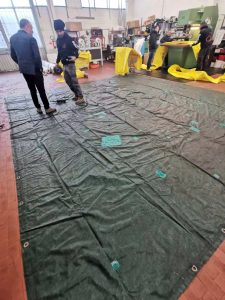
Technical staff inspecting coated fabric in the workshop
Polymer-Coated Barrier Fabric
- Polymer-Coated Fluid Barrier:Constructed with a dense base fabric paired with a compact PVC/PU protective coating, providing hydrophobic and oil-repellent surface properties designed to prevent penetration from localized industrial oils and specified chemical liquid splashes in designated drum-filling and maintenance areas.
- Easy-Clean Coated Surface:The smooth coated surface was designed to simplify routine cleaning in liquid-handling environments. Daily maintenance can be performed by wiping with a damp cloth or rinsing under low-pressure water according to the provided garment care instructions.
Reinforced Construction & Ergonomic Harness
- Heat-Sealed Seams at Specified Joints:Heat-sealing technology was applied at designated seams and edge joints to reduce potential fluid seepage through stitch holes, helping maintain barrier integrity during routine liquid handling.
- Adjustable H-Back Harness & Fitting Buckles:An H-style shoulder harness was chosen to help balance weight distribution across the shoulders, designed to help reduce pressure on the neck compared to traditional neck-loop aprons. Durable polymer buckles allow quick fitting and size adjustments for operators wearing varying inner layers.
3. Verification & Project Delivery
- Internal Fabric & Assembly Evaluation:Fabric samples underwent preliminary fluid-contact and physical abrasion evaluations during the sampling phase. Sample swatches were assessed for surface durability and coating adhesion after repeated flexing, ensuring the material structure met basic strength requirements before mass production.
- Shop-Floor Trial & Wearer Feedback:Initial sample aprons were assigned to selected operators in drum-filling and maintenance stations during a trial period. Trial participants provided feedback regarding overall wearing comfort, practical coverage during fluid handling, and the convenience of wiping surface residues clean during daily shifts.
- Project Completion & Technical Alignment:Following the order delivery and initial on-site inspection, the custom protective aprons were deployed across designated liquid-handling departments. The LEAPY team subsequently visited the client's office and manufacturing facility in Italy to review product performance in active shop-floor environments and align on potential workwear requirements for upcoming production cycles.
Project Completion & On-Site Review
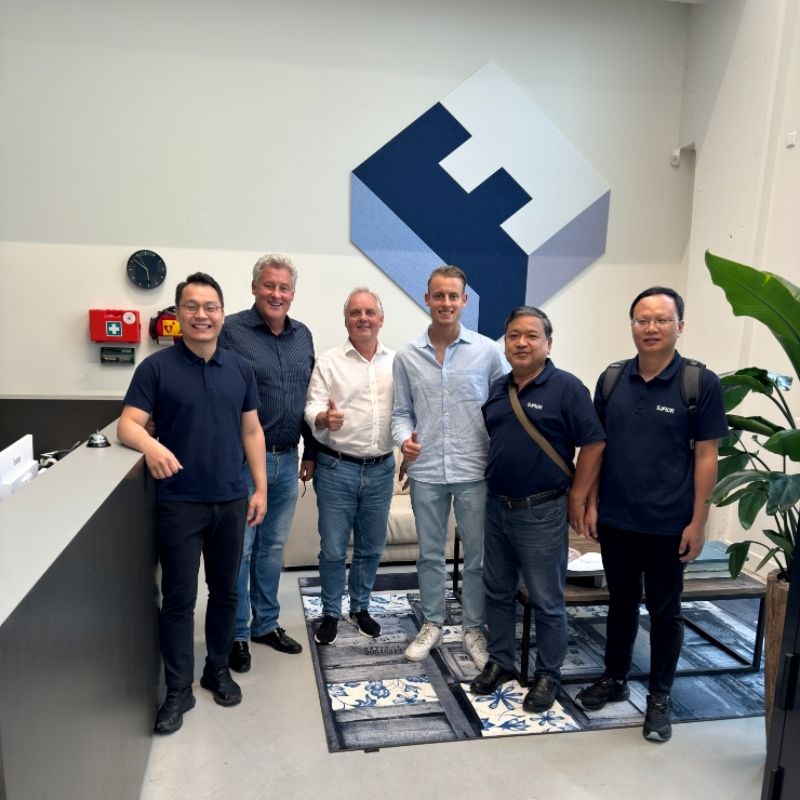
Following order delivery, the custom protective aprons were deployed to designated liquid-handling departments. During a subsequent site visit to the client's facility in Italy, LEAPY's technical representatives met with the client team to confirm garment fit under active working conditions and review sizing and material feedback for future production orders.

LEAPY representatives meeting with the client's team in Italy to review program feedback
Discuss Your Custom Apron Requirements
To evaluate a protective apron solution for your facility, share your operational details with our team—including the specific fluids handled, splash conditions, required apron dimensions, and estimated order quantity.
Related projects

- Professional Workgear
- Professional Workgear
- Professional Workgear